

"An all-white room with a wall as a splash of colour seems pointless"
Interior designer Mierta Lazzarini talks about what influences her choice of colour and the role of the Engadine light in her work.
Ms Lazzarini, you are an interior designer and your husband is an architect. You have been working together for 35 years. Does the inside determine the outside or vice versa?
It's important to me to understand what my husband wants to achieve with his project. I base the colour scheme and lighting design on his idea. As part of our current renovation project in Uitikon-Waldegg, I've even been involved in selecting the curtains and some of the furniture. The previous owners had become accustomed to certain things. The pictures, for instance, had to be kept in their place. My job is to present them in a better way. To achieve this, I contrast them with the wall paint. Conversely, I make some furniture 'disappear' by painting the wall the same colour as the furniture. In this house, everything should fit together. The house is to be given a kind of 'identikit', a visual appearance.
Do you use standardised colour scales in your work, such as Le Corbusier's Polychromie Architecturale?
I like the colours that Le Corbusier chose for his colour scales. I have already used them. Le Corbusier went to great lengths to create his palettes and the accompanying work aid. He was keen for people to live with the 'Le Corbusier style'.
Le Corbusier speaks of the fact that colour is closely linked to essence. In other words, colour is subjective.
Whether two colours go together is purely a matter of feeling. Like music, colours also touch the soul. You can start from your own sense of well-being. Architects don't always know how to deal with colours. This is why they often dress in black. They don't want to make a mistake. Le Corbusier does not justify his choices. Personally, I now prefer to work with less limited palettes and have my own criteria for choosing colours.
What criteria do you use to choose colours?
I have to pay attention to a lot of little things. Firstly, I consider the material. Is it wood or plaster? Is the plaster coarse or fine? Coarse plaster creates a lot of shade. Additionally, the colour appears different on each wall because the light falls unevenly. That's why I always choose a lighter colour for the ceiling than for the walls. The window frame always appears dark, regardless of the brightness setting, because of the backlight. But there is something I vehemently reject, which is an all-white room with a wall as a splash of colour. That seems pointless.
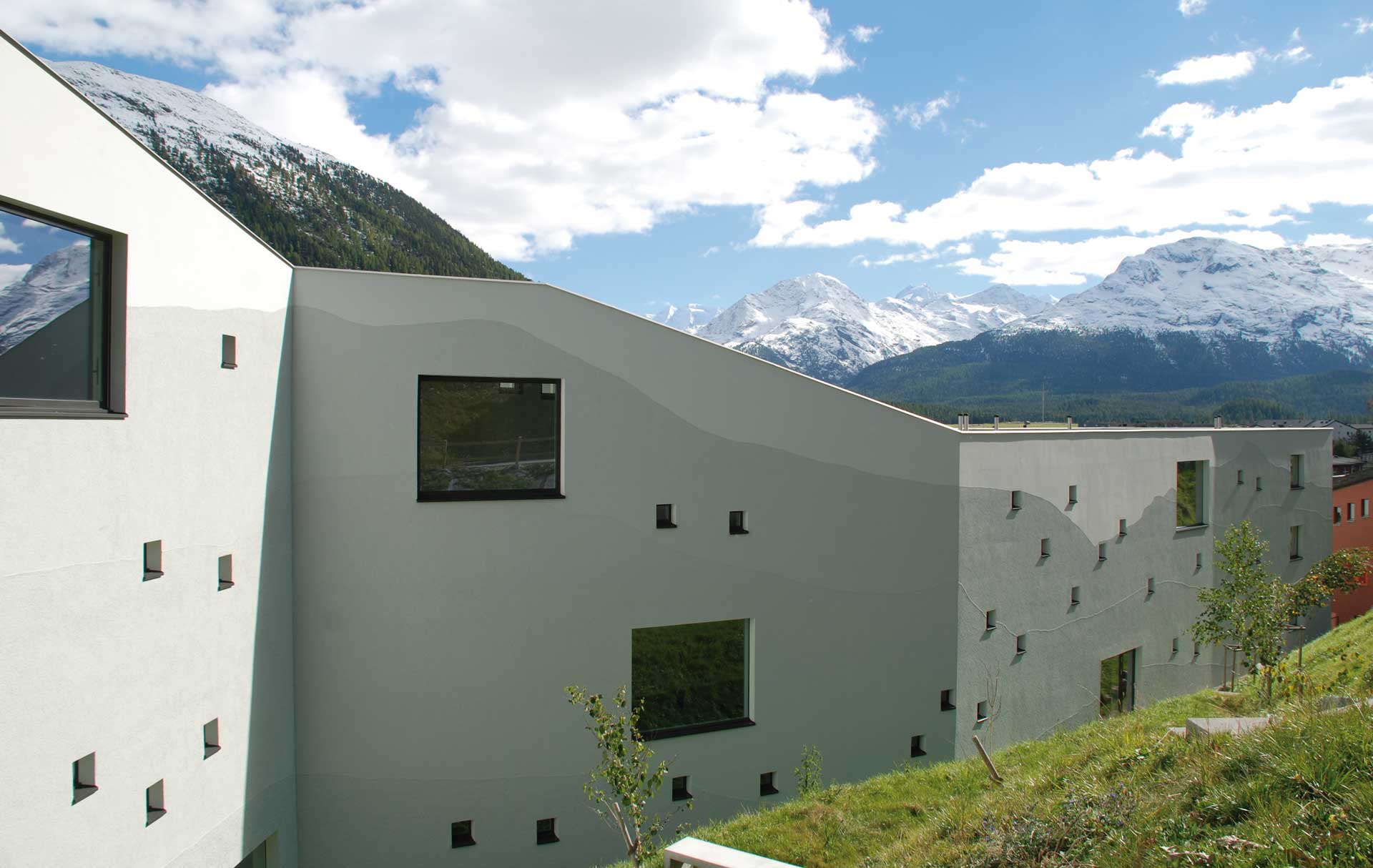
The surroundings influence the design of the façade: the staff house in Samedan.
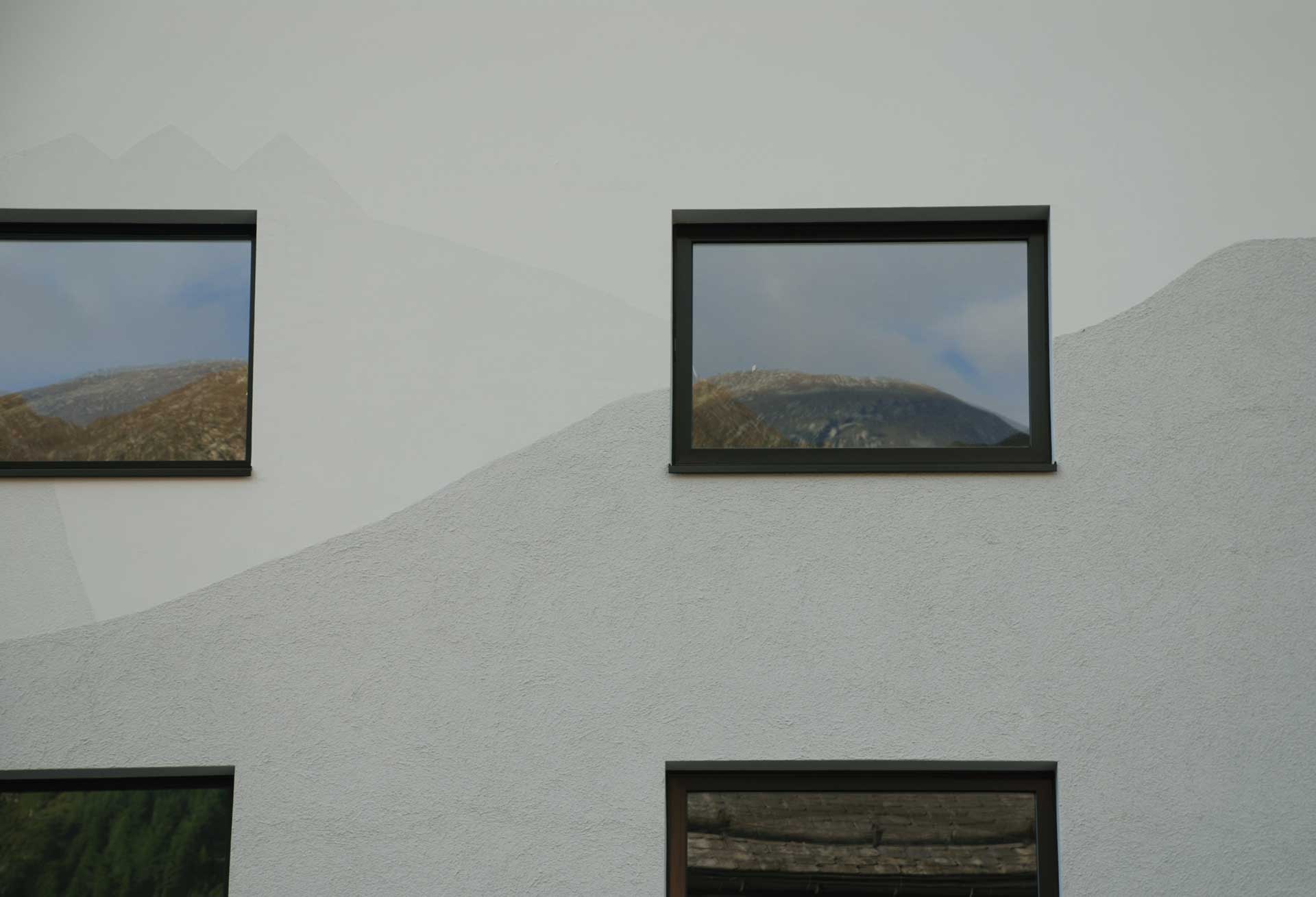
How does the interior colour scheme affect the exterior?
To me, windows are the 'face' of a house. From the outside, they always appear dark. But what happens to a house when the shutters are closed on one window? The window must continue to form a coherent whole with the others. Otherwise, the house looks cross-eyed. That's why light-coloured roller shutters seem out of place to me. For the current renovation project, I chose lined curtains. The side of the curtain facing the window is dark, so the external appearance of the house is not affected when it is closed.
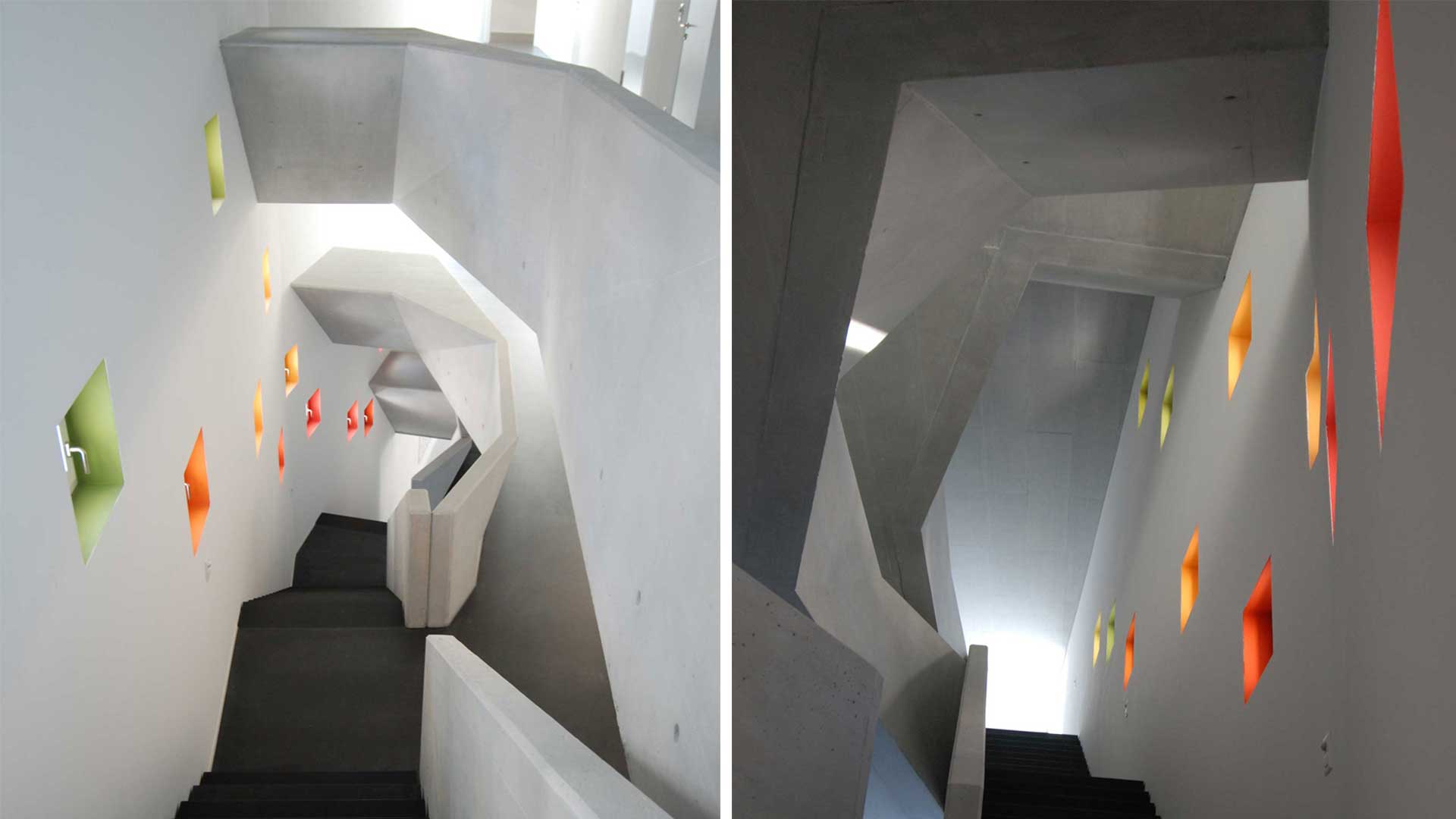
The staff house in Samedan uses coloured window openings as a colour-coding system.
You live and work in Samedan. The Engadin is renowned for its unique light. How do you address this in your approach to spatial planning?
My husband designs houses that make the most of the light. He observes where the sun rises and sets. We always want to let light into the house. But we don't want it to be too bright. We like the Scandinavian approach to it. They bring warmth into the home. We achieve this by buffering the cold, snowy light with a warm wall. However, we once had a client who wanted a bedroom without any windows, like a fox's den. We complied with their request.
The staff house in Samedan, which you completed in 2008, is an interesting project in terms of the use of colour.
The outer wall is decorated with a sgraffito featuring different layers of plaster. The mountain landscape is depicted in mirror-inverted form. The artist Gregori Bezzola used this traditional local method. The interior design was intended to guide people into their homes. The staircase is very winding. I developed a kind of companion system comprising coloured window niches that extend from the red area to the green. When the sun shines in, the effect is very lively. There is also a guidance system in the old staff house. Attached to the floor, it resembles hospital signage. We wanted to avoid that.
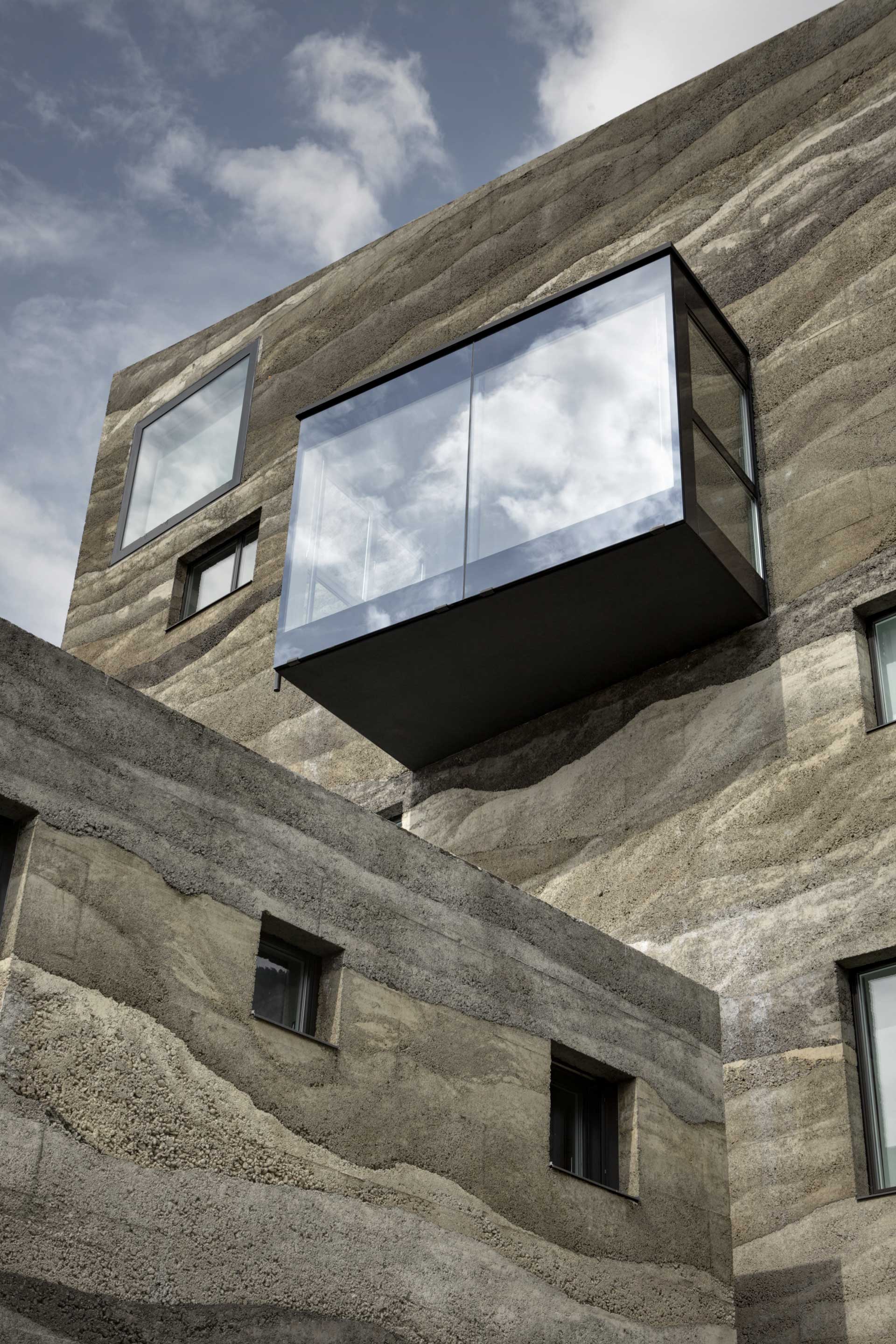
Giardin housing complex: experiment on the façade
The Giardin development won an award in recognition of its colour, structure and surface finish. How did architecture and interior design interact in this context?
The living spaces are very simple in design because the client wanted them that way. However, an interesting system from the 1930s was used on the outside. The tamped concrete construction is purely decorative and hangs on the façade. We had to have the load capacity tested by Empa. In some months, the temperature can differ by as much as 60 degrees in a single day. During the day, the sun shines on the dark façade and, in the evening, it freezes. We created many different patterns. Implementing them was a great challenge for everyone involved. We mixed the colours on site using a recipe of brown and yellow pigments with a touch of red. We wanted warm dark brown and sandy yellow tones, but definitely not grey. With each new concrete delivery, we became more and more nervous. The bricklayers had not really understood our vision. We wanted wavy ribbons, but they started creating ocean waves reminiscent of those in a children's book. Luckily, we started with the back wall. First, they had to let go of their own ideas. Now, each wall looks different.
Regazzi is a licensee of Les Couleurs® Le Corbusier®. Les Couleurs Suisse AG is the exclusive worldwide licensor of the Le Corbusier colours – granted by the Fondation Le Corbusier®. Les Couleurs® Le Corbusier® is a registered trademark of Les Couleurs Suisse AG.
About
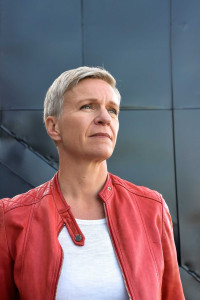
Mierta Lazzarini-Kaiser is a qualified interior designer. Born in Zuoz in 1964, she initially worked as an advertising assistant and jewellery designer. After studying interior design in Milan, she and her husband Kurt Lazzarini founded an architectural office in Samedan in 1998.